EV charging hub for Sliabh Liag sparks drive for more across Donegal - Donegal Daily
By Rachel McLaughlin · Donegal Daily · 3 October 2026
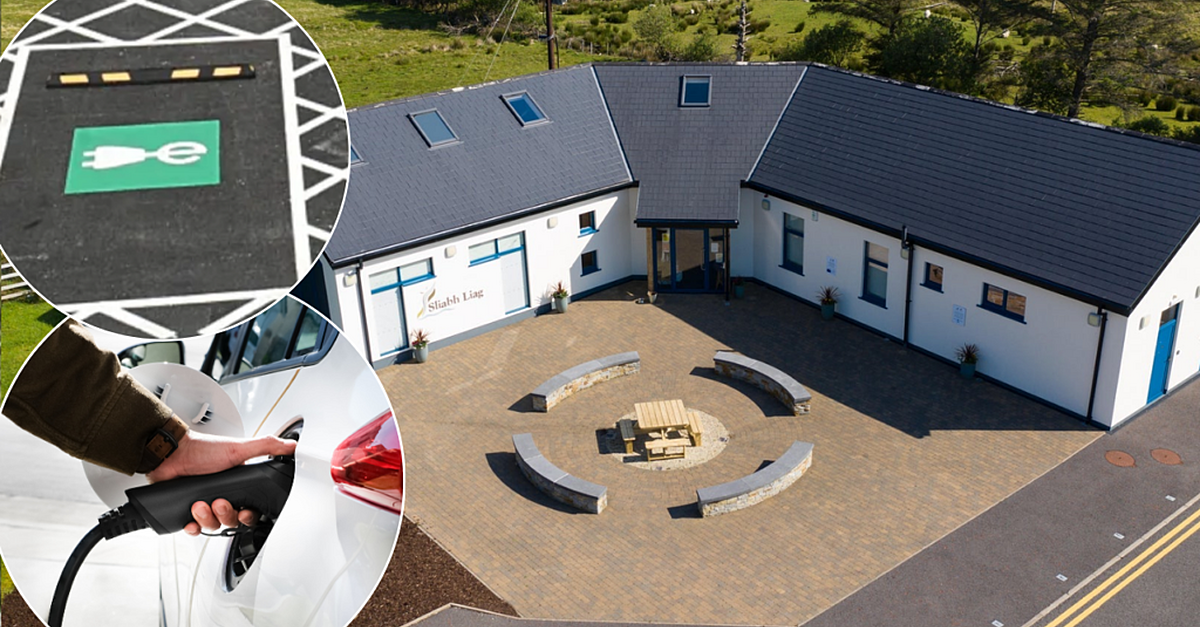
Donegal councillors have called for a wider rollout of EV chargers as Sliabh Liag prepares to become a pilot site for destination charging.The Sliabh Liag Visit...
Donegal councillors have called for a wider rollout of EV chargers as Sliabh Liag prepares to become a pilot site for destination charging.
The Sliabh Liag Visitor Centre car park is set to receive four charging units providing eight charging points, as part of a pilot being developed by Donegal County Council in collaboration with Zero Emission Vehicles Ireland (ZEVI).
The iconic Sliabh Liag cliffs attract approximately 160,000 visitors each year, but there is currently no publicly accessible EV charging infrastructure serving the Sliabh Liag Visitor Centre or the wider Teileann area.
The nearest existing charging facilities are around 20km away in Killybegs and 35km away in Glenties.
Eight dedicated EV charging bays are set to be created, while the existing car park will also be reconfigured to provide six additional standard parking spaces.
Members of Donegal County Council gave Part 8 approval to the pilot project this week, but many said the investment highlighted the need to look at charging provision much more widely across Donegal.
Cllr Ali Farren welcomed the Sliabh Liag project as “fantastic and much needed”, but highlighted Malin Head and Fanad Lighthouse among locations which could also benefit.
The discussion also brought up charging problems for people who cannot simply plug an electric car in at home.
Buncrana Cllr Jack Murray said residents of town centres who live on terraced streets and other properties who don't have private driveways cannot install conventional home chargers. He questioned what role the council could play as EV ownership increases.
“This is going to be an issue, and it will grow and grow as an issue in urban streets across the town,” he said.
Cllr Murray spoke about solutions he had seen elsewhere, including channels built into footpaths which allow charging cables to be safely run from a house to a vehicle. He also described systems where cables can be carried above pedestrians before dropping down to a parked car.
The issue is one the council is actively considering under what is known as “neighbourhood charging”.
Director of Roads and Transportation Bryan Cannon explained that neighbourhood facilities could involve chargers being located in local car parks or other centres, allowing people without driveways to leave vehicles charging slowly overnight.
He said the developing EV strategy is looking at both destination charging, such as at tourist attractions, and neighbourhood charging for local residents.
Donegal County Council is the lead local authority for developing that work across the northern and western part of the Wild Atlantic Way region, incorporating Clare, Galway County, Mayo, Sligo and Donegal.
While Transport Infrastructure Ireland (TII) leads the provision of charging on the national road network, regional and local plans will focus on destination and neighbourhood charging. A consultation process on the developing strategy is also expected to take place.
Award-winning Donegal mum shining a light on special needs families
Mr Cannon stressed, however, that Donegal County Council is not intending to become an operator selling electricity to motorists itself.
"The council wasn’t in the role of providing fuel to vehicles heretofore, and the council isn’t going to be in the business providing fuel to vehicles going forward,” he told councillors.
Instead, he said the council and ZEVI have a role in helping to ensure that the market provides the infrastructure necessary for the transition to electric vehicles.
He outlined three broad areas of charging provision: en-route, destination and neighbourhood charging.
En-route charging is largely aimed at motorists travelling longer distances on the road network. Mr Cannon said around 15 locations in Donegal had received grants under schemes which enable private businesses such as filling stations and supermarkets to install charging infrastructure.
Destination charging, meanwhile, is aimed at locations people specifically travel to and spend time at, allowing them to charge while visiting an attraction.
Funding for the Sliabh Liag project has been approved through ZEVI, with Mayo County Council taking responsibility for procuring and appointing a Charge Point Operator on behalf of Donegal and other participating Region 7 authorities.
Mr Cannon said ZEVI had asked Donegal to run the destination pilot there to see how it operates in practice.
The Sliabh Liag hub will include one 200kW DC charging unit with two charging points, one 100kW DC unit with two points and two 22kW AC units providing four further points.
Councillors told Monday's Plenary meeting how a wider EV strategy was necessary across Donegal.
Glenties Cllr Anthony Molloy said the lack of infrastructure is placing pressure on a local 50-bedroom hotel in Ardara, which he said was losing business because of the lack of EV charging points.
Inishowen Cllr Martin McDermott also raised concerns about his area, warning that the focus on charging facilities along national roads could leave Inishowen at a disadvantage because the peninsula does not have national primary roads.
"We need a strategy, and that’s what we’re working on, to ensure that the likes of Ardara, the likes of Malin Head, the likes of the different places that people are talking about, will have that infrastructure there to serve the people, to ensure that we can attract the tourists, but also then serve the locals that need it within the neighbourhood," he said.
The debate comes as electric vehicle uptake continues to accelerate nationally.
Society of the Irish Motor Industry (SIMI) figures for January to September show 35,195 new battery-electric cars were registered across Ireland, up 57.3% on the same period in 2025. Battery-electric cars accounted for 27.43% of the national new-car market over the period.
In Donegal, 2,852 new cars of all engine types were registered in the first nine months of 2026, up 4.01% from 2,742 during the same period last year.
Reporting by Rachel McLaughlin for Donegal Daily, funded by the Local Democracy Reporting Scheme. Republished by News Room under the scheme’s reuse permission.
About News Room →